
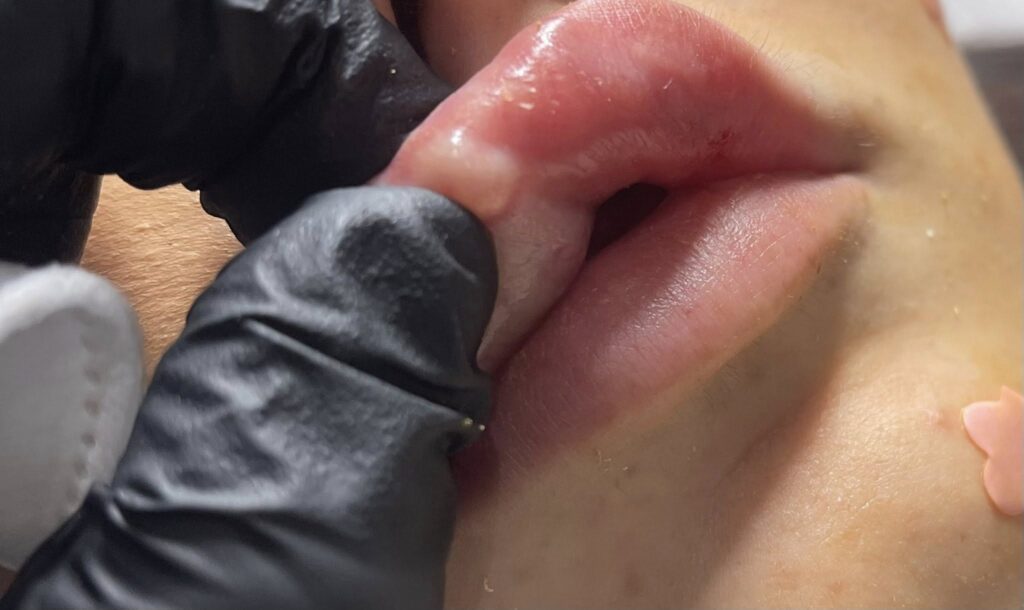
How Long Do Lip Filler Lumps Last?
Most lip filler lumps disappear within 7 to 14 days as swelling decreases and the hyaluronic acid filler integrates with the surrounding lip tissue.
However, some lumps may last longer if they are caused by:
- bruising (hematoma)
- filler clumping
- encapsulation
- delayed inflammatory nodules
If a lump remains after two to four weeks, a follow-up appointment with your injector is recommended.
Lip fillers are one of the most common non-surgical cosmetic procedures in the world. Most modern fillers contain Hyaluronic Acid (HA), a naturally occurring molecule in the skin that attracts water and adds volume.
Are Lumps Inside the Lip Normal After Filler?
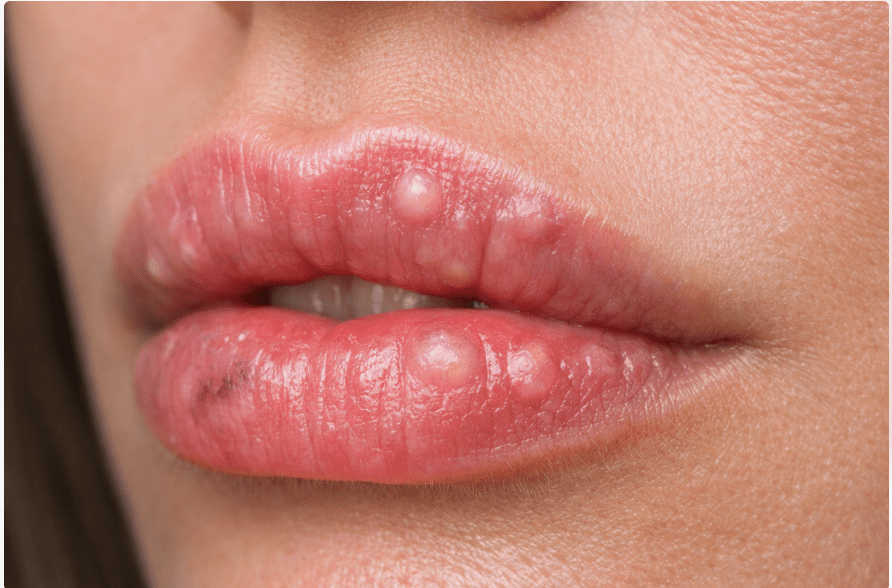
Yes — in most cases, lumps after lip filler are a normal part of the healing process.
During the first 14 days after treatment, several biological processes occur inside the lip tissue:
• swelling caused by fluid retention
• mild inflammation from needle trauma
• filler gel settling into tissue layers
• temporary bruising under the skin
Because hyaluronic acid fillers attract water, they can temporarily expand inside the tissue, creating firm or uneven areas.
These small nodules are usually most noticeable along the wet-dry border of the lips, where the inner mucosal tissue meets the outer lip surface.
According to the American Society of Plastic Surgeons, mild swelling, bruising, and small lumps are common side effects of dermal filler injections.
To understand how your swelling will change daily, check out our complete lip filler healing process day by day guide.
Why Lumps in Lips After Filler
Lip filler lumps usually occur because of four common clinical factors.
Understanding these causes helps determine whether the lump will disappear naturally or requires treatment.
1. Subcutaneous Hematoma (Deep Bruising)
One of the most common reasons for lumps after filler is a subcutaneous hematoma.
During the injection process, the needle may accidentally puncture a small blood vessel. This causes blood to collect beneath the skin, forming a firm bruise that feels like a small marble.
Signs of a hematoma include:
• purple or dark discoloration
• tenderness when pressed
• firmness under the skin
This type of lump is not filler itself, but rather trapped blood from the injection trauma.
Bruises usually resolve within 5 to 10 days.
If you are experiencing dark spots and tenderness, read our comprehensive guide on how to treat purple bruising after lip fillers safely.
2. Hydrophilic Swelling From Hyaluronic Acid
Hyaluronic acid has a powerful ability to bind water molecules.
After injection, HA fillers begin absorbing fluid from surrounding tissue. This process is called hydrophilic expansion.
As the filler hydrates, the lips may temporarily feel:
• tight
• firm
• slightly uneven
• swollen in specific areas
This swelling peaks during the first 48 to 72 hours.
Once the body begins metabolizing excess fluid, the swelling gradually decreases and the filler integrates into the lip tissue.
3. Filler Rheology and Product Thickness
Different lip fillers have different rheological properties.
The most important property is called G-prime (elasticity).
Fillers with a higher G-prime are thicker and hold their shape better. However, if a thick filler is injected into naturally thin lips, the tissue may struggle to accommodate the product.
This can cause the filler gel to cluster together instead of spreading evenly, creating visible nodules.
Additionally, if the filler is injected too superficially (too close to the surface of the lip), it can create a lump with a bluish tint. This is known in aesthetic medicine as the Tyndall effect, and it usually needs to be dissolved.
Product quality plays a huge role in preventing lumps. Discover what is the safest lip filler to use for smooth, natural results.
4. Encapsulation of Filler
Sometimes the immune system treats filler as a foreign substance.
Before the filler has fully integrated into the lip tissue, the body may form a small protective layer around it. This process is known as encapsulation.
Encapsulated filler may feel like:
• a small pearl-shaped bump
• painless but firm
• noticeable when pressing the lips together
These lumps often soften naturally over time.
5. Delayed-Onset Nodules (Rare Complication)
Occasionally, lumps appear months after the original filler treatment.
These delayed lumps are known as Delayed-Onset Nodules (DONs).
Possible causes include:
• immune system reaction
• bacterial biofilm
• viral illness triggering inflammation
• filler degradation products
Delayed nodules require professional evaluation by a qualified injector or dermatologist. In rare cases, the body’s immune system walls off the filler months later, creating a hard, inflammatory bump known as a granuloma. These often require medical intervention with steroids or hyaluronidase.
However, one of the most alarming experiences for patients after lip injections is feeling lumps inside the lips after filler. These bumps can appear within hours or days after treatment and may feel hard, uneven, or tender.
In most cases, these lumps are completely normal and temporary. They usually occur because the filler is still integrating with the surrounding tissue and the lips are experiencing post-injection swelling.
Understanding why lip filler lumps occur, when they are harmless, and when they require medical attention is essential for a safe recovery.
The 14-Day Lip Filler Healing Timeline
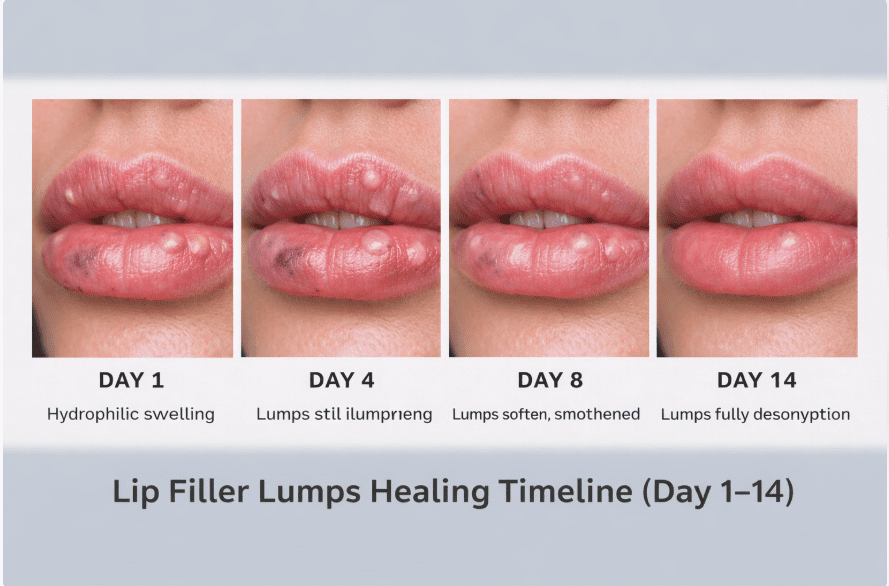
Most aesthetic practitioners follow a 14-day observation period before recommending treatment for lumps.
During these two weeks, the filler undergoes natural integration.
Day 1–3: Acute Swelling Phase
During the first few days:
• lips feel firm and swollen
• multiple small lumps may appear
• tenderness is common
This is caused by inflammation and water absorption.
Do not massage the lips during this stage.
Day 4–7: Early Tissue Integration
Swelling begins to decrease.
However, as swelling fades, specific lumps may become more noticeable.
This is normal and often related to bruising or localized filler concentration.
Day 8–13: Softening Phase
The filler begins blending with the natural lip tissue.
During this stage:
• lumps soften
• lips feel more natural
• asymmetry improves
Day 14: Final Settling Phase
By two weeks, most filler should feel smooth.
If a hard, visible nodule remains, a follow-up appointment with the injector is recommended.
Safe Lip Filler Massage Techniques
If lumps persist after the first week, some injectors may recommend gentle massage.
Massage helps redistribute filler and soften encapsulated areas.
However, incorrect massage can push filler outside the lip border and cause lip filler migration.
Incorrect massage techniques can push the gel outside the vermilion border, leading to a migrated lip filler.
The Pinch and Roll Massage Method
This technique is often recommended for small nodules.
Step-by-step method:
- Wash your hands thoroughly.
- Apply a small amount of lip balm or Aquaphor.
- Locate the lump inside the lip.
- Place one finger inside the mouth behind the lump.
- Place your thumb on the outside of the lip.
- Gently pinch the tissue.
- Roll your fingers slowly over the lump.
Massage should last no longer than 60 seconds.
Repeat twice per day only.
When You Should NOT Massage Lip Filler
Never massage your lips if:
• it has been less than 48 hours since injections
• the lump is bruised or painful
• the skin feels hot or inflamed
• there is severe swelling or throbbing pain
In these cases, massage could worsen the condition.
Lip Filler Migration: A Common Risk of Over-Massaging
Excessive pressure on freshly injected filler can cause it to move outside the lip border.
This creates an unnatural shelf above the lip known as filler migration.
Common signs include:
• volume above the upper lip
• blurred vermillion border
• unnatural lip projection
If you notice an unnatural shadow above your mouth, learn how to identify the early signs of a migrated lip filler and how to fix it.
When Lip Filler Lumps Require Dissolving
Most filler lumps resolve naturally. However, some situations require medical treatment.
The most common solution is Hyaluronidase, an enzyme that dissolves hyaluronic acid filler.
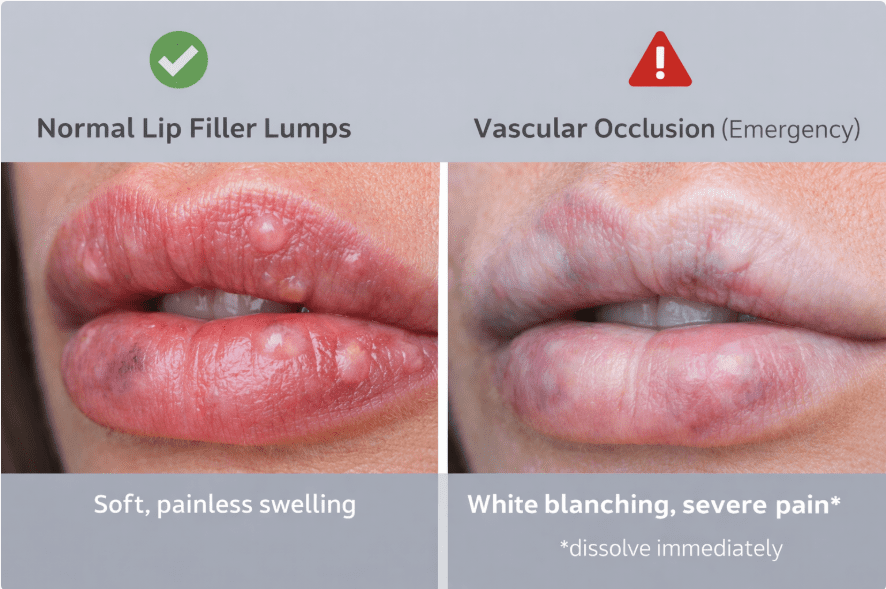
Medical Emergency: Vascular Occlusion
A rare but serious complication of filler injections is vascular occlusion.
This occurs when filler blocks blood flow inside a vessel.
Warning signs include:
• intense pain
• pale or white skin
• skin discoloration
• cold skin temperature
One of the most critical warning signs of an occlusion is blanching (the skin turning pale or white) accompanied by a mottled, net-like pattern on the surrounding tissue. This means the blood supply is compromised. This condition requires immediate medical treatment.
Cosmetic Reasons for Dissolving Filler
Some lumps may need dissolving for aesthetic reasons.
Dissolving may be recommended if:
• lumps remain after 3–4 weeks
• lips appear uneven
• the filler affects speech or smiling
• migration has occurred
Modern clinics sometimes use ultrasound-guided dissolving, which allows injectors to precisely target the filler pocket.
Cost Considerations When Correcting Lip Filler
Many patients worry about losing volume when dissolving filler.
In some cases, only a small amount of filler must be dissolved.
For example, correcting asymmetry may require only half a syringe during refill.
If you only need a minor correction or volume boost, find out exactly how much half a syringe of lip filler is and explore realistic half syringe lip filler before and after results.
How to Prevent Lip Filler Lumps
Preventing lumps begins with choosing the right injector, technique, and filler type.
Choose an Experienced Injector
An experienced injector understands lip anatomy, including:
• vermillion border
• orbicularis oris muscle
• superior labial artery
Poor injection depth is a common cause of lumps.
Use Appropriate Lip Filler Volume
Overfilling thin lips increases pressure inside the tissue.
Patients with thin lips should often start with 1 ml or less.
Patients with naturally thin lips should start with smaller amounts to avoid lumps. View our realistic 1ml lip filler before and after for thin lips gallery to set the right expectations.
Choose the Right Lip Shape
Different lip techniques distribute filler differently.
Some styles, such as Russian lip filler, use micro-droplet injections to reduce clumping.
Certain injection methods, like the Russian lip filler technique, use micro-droplets that significantly reduce the risk of clumping and lumps.
Avoid Pressure on Lips After Treatment
Post-treatment behavior is extremely important.
During the first 48 hours:
• avoid straws
• avoid kissing
• avoid sleeping on your side
Sleeping pressure can push filler to one side.
Nighttime pressure can shift the fresh gel and create lumps. Read our guide to find out: Can I sleep on my side after lip filler?
Special Considerations for Men and Women
Lip anatomy differs between genders.
Men often have:
• thicker skin
• stronger lip muscles
• deeper injection planes
This means filler placement must be adjusted accordingly.
Because of these anatomical differences, male treatments require specific techniques to avoid lumps. Check out these lip filler for men before and after transformations.
Final Verdict
Finding lumps inside your lips after filler can feel alarming, but in most cases it is a temporary and harmless stage of the healing process.
During the first two weeks, swelling, bruising, and filler integration can cause uneven texture inside the lips.
The most important steps are:
• be patient during the healing period
• avoid excessive touching or massage
• monitor symptoms carefully
If lumps remain after two to four weeks, consult your injector for evaluation.
Most issues can be corrected safely with minor adjustments or dissolving.
Frequently Asked Questions
Do lip filler lumps go away on their own?
Yes. Most lumps disappear naturally within two weeks as swelling decreases and the filler settles into the tissue.
Why does my lip filler feel hard?
Lip fillers feel hard during the first week because hyaluronic acid attracts water. This causes temporary swelling and firmness in the lips.
Can massaging lip filler make it worse?
Yes. Massaging too early or too aggressively can push filler outside the vermillion border, causing lip filler migration.
When should I dissolve lip filler lumps?
Lip filler should be dissolved if:
- lumps remain after 4 weeks
- filler has migrated
- there is severe asymmetry
- vascular occlusion is suspected
Are lumps after lip filler dangerous?
Most lumps are harmless and caused by swelling or bruising. However, severe pain, skin blanching, or discoloration may indicate a vascular complication requiring urgent medical attention.
Medical Disclaimer
This article is for educational purposes only and does not replace professional medical advice. Always consult a qualified cosmetic practitioner, dermatologist, or plastic surgeon before undergoing any filler treatment or attempting corrective techniques.
Trusted Medical Sources
The information in this guide aligns with educational resources from:
- American Society of Plastic Surgeons (ASPS): Dermal Fillers: Procedure, Safety, and Risks
- Cleveland Clinic: Lip Fillers: What to Expect, Healing & Side Effects
- WebMD: Lip Augmentation Overview & Cosmetic Safety
- Healthline: Everything You Need to Know About Lip Fillers & Aftercare

Sarah Mitchell is a dedicated aesthetic researcher with over a decade of experience analyzing cosmetic procedures. Obsessed with data and safety, she helps patients to provide real words and navigate the world of lip fillers with verified before and after results and honest cost breakdowns.
Pingback: Migrated Lip Filler: 5 Signs, Causes & How to Fix It Fast - Lip Filler Results
Pingback: Can You Get Lip Filler While Pregnant? Risks, Rules & What If You Already Did - Lip Filler Results
Pingback: Half Syringe Lip Filler Before and After (0.5ml): Cost & Results - Lip Filler Results
Pingback: The Ultimate Lip Filler Before and After Results 2026 Guide - Lip Filler Results