
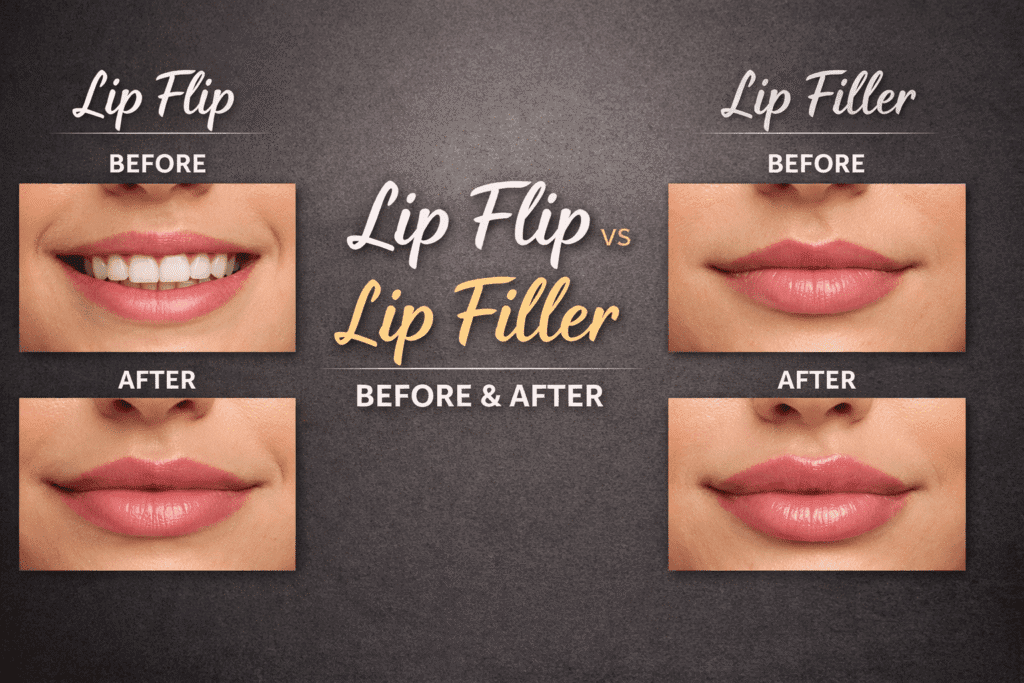
Introduction: The New Era of Lip Enhancement
Over the last few years, cosmetic facial aesthetics have shifted from an “overfilled” look to a desire for hyper-natural, balanced facial harmony. If you are searching for lip flip and filler before and after results, you are likely wondering how to achieve a fuller pout without looking artificial.
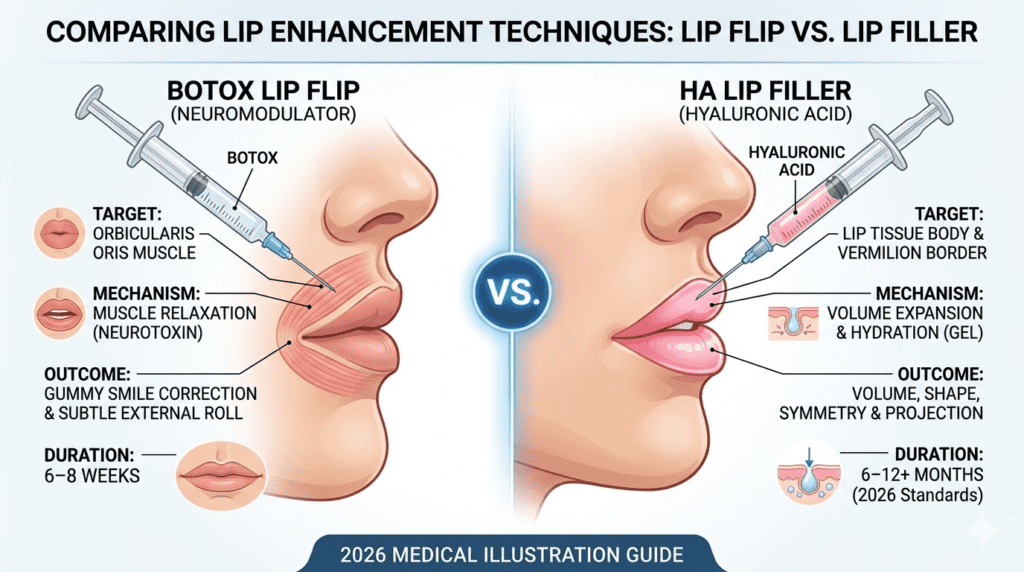
Today, board-certified dermatologists and expert cosmetic injectors frequently recommend combining a Botox lip flip with hyaluronic acid (HA) lip fillers. While lip fillers physically add volume to the lip tissue, a lip flip uses neuromodulators (like Botox, Dysport, or Xeomin) to relax the orbicularis oris muscle, allowing the upper lip to gently roll outward.
Whether you are looking to correct a gummy smile, define your cupid’s bow, or add significant hydration and plumpness, understanding the deep anatomical differences between these two treatments is your first step toward achieving your dream smile.
What is the difference between a lip flip and a lip filler?
A lip flip uses neuromodulators (like Botox) to relax the muscles around the mouth, rolling the upper lip outward for a subtly fuller look without adding volume. A lip filler uses Hyaluronic Acid (HA) gel to physically inject volume, shape, and hydration into the lip tissue. While a lip flip lasts 6 to 8 weeks, lip fillers can last 6 to 12 months.
Comprehensive Comparison: Lip Flip vs. Lip Filler vs. Combination Treatment
To make an informed decision, it is crucial to understand the distinct variables of each procedure. Here is a detailed clinical and aesthetic breakdown:
| Feature / Metric | Botox Lip Flip | Hyaluronic Acid Lip Filler | Combination (Flip + Filler) |
| Primary Goal | Upper lip eversion & gummy smile correction | Volume, hydration, and symmetry correction | Balanced shape, volume, and projection |
| Active Ingredient | Botulinum Toxin Type A | Cross-linked Hyaluronic Acid (HA) | Both |
| Average Dosage | 4–6 Units | 0.5ml to 1.0ml (Half to Full Syringe) | 4-6 Units + 0.5ml-1ml Filler |
| Longevity | 6 to 8 weeks | 6 to 12 months (depending on metabolism) | Mixed (Botox fades first, filler remains) |
| Onset of Results | 5 to 7 days | Immediate (Final results in 14 days) | Immediate volume; Flip takes 5-7 days |
| Reversibility | Wears off naturally over time | Instantly reversible with Hyaluronidase | Filler is reversible; Botox wears off |
| Pain Level | Very Minimal (Quick pinch) | Mild to Moderate (Numbing cream used) | Mild to Moderate |
| Estimated Cost (2026) | $100 – $300 | $500 – $1,000 per syringe | $600 – $1,300+ |
Deep Dive: What Exactly is a Botox Lip Flip?
A lip flip is an advanced, non-surgical cosmetic procedure designed to enhance the natural anatomy of the mouth. Instead of using a volumizing gel, an aesthetic provider injects micro-doses of Botulinum toxin directly into the orbicularis oris—the circular muscle complex that surrounds the mouth and controls lip movement.
How the Science Works
When we smile, the orbicularis oris muscle contracts tightly. In some patients, this contraction pulls the top lip inward, making it disappear, or pulls it up too high, revealing excessive gum tissue (a gummy smile). By injecting just 4 to 6 units of Botox, the muscle’s top layer relaxes. As a result, the resting tension releases, and the upper lip “flips” slightly upward and outward.
Best Candidates for a Lip Flip:
- Patients whose upper lip curls inward or thins out when smiling.
- Individuals seeking a very subtle, temporary change before committing to fillers.
- Patients looking to fix a prominent “gummy smile.”
Deep Dive: The Science of Dermal Lip Fillers
Unlike the muscle-relaxing properties of a lip flip, dermal lip fillers are structural and volumizing. Modern lip fillers are almost exclusively formulated from Hyaluronic Acid (HA), a naturally occurring sugar molecule in the human body capable of holding 1,000 times its weight in water.
Strategic Placement for Facial Harmony
Experienced injectors don’t just “fill” lips; they sculpt them. Using advanced techniques, fillers can be placed into the vermilion border (the lip outline) for crisp definition, the body of the lip for pillow-like volume, or the philtral columns to enhance the cupid’s bow.
If you are dealing with naturally thin lips and want to know exactly what to expect from volume enhancement, it is highly recommended to review realistic 1ml lip filler before and after results for thin lips to set accurate expectations. Furthermore, understanding your natural facial anatomy is critical; exploring a comprehensive lip filler shape guide can help you and your injector choose a style—whether that is a classic natural pout, a keyhole pout, or a structured aesthetic—that perfectly complements your facial dimensions.
The Magic of Combination: Lip Flip and Filler at the Same Time
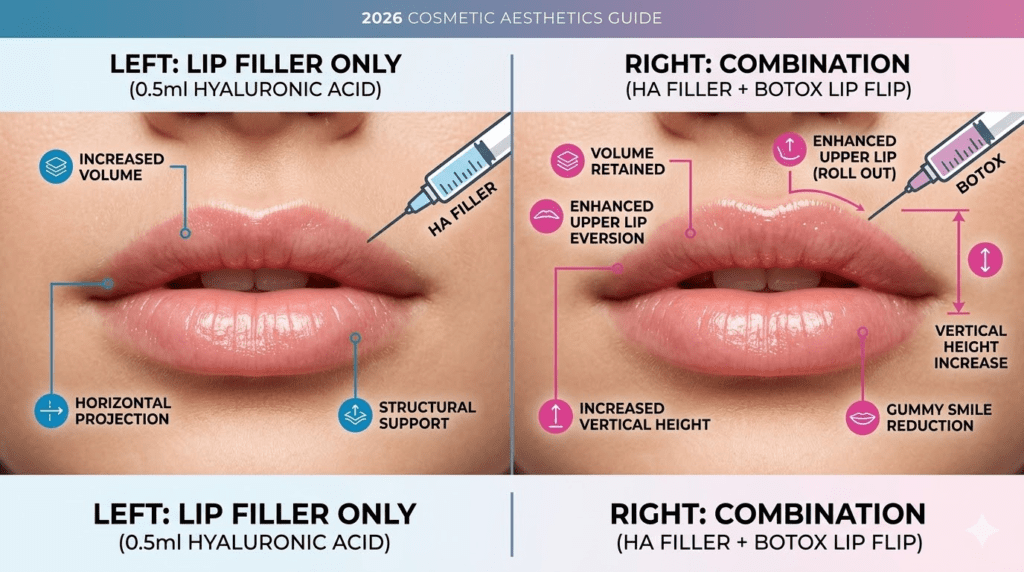
While a Botox lip flip and dermal fillers are exceptional standalone treatments, combining them has become the gold standard in cosmetic clinics across the United States in 2026. Patients frequently ask, “Can you get a lip flip and filler at the same time?” The answer is absolutely yes. In fact, many board-certified injectors prefer this synergistic approach for achieving optimal facial harmony.
Why Combine Botox and Hyaluronic Acid?
To understand the power of this combination, you have to look at lip anatomy from a structural and functional perspective.
- The Filler (Structure): Hyaluronic acid acts as the architectural framework. It restores lost volume, smooths out fine perioral lines (smoker’s lines), and provides physical hydration from within the dermal matrix.
- The Flip (Function): Botulinum toxin modifies the mechanical function of the orbicularis oris muscle. By releasing the downward pull of this muscle, the upper lip naturally resting position shifts outward.
When used together, the filler prevents the lip from looking flat, while the lip flip maximizes the visible pink tissue (mucosa) of the upper lip without requiring excessive amounts of filler. This prevents the dreaded “duck lip” or over-projected appearance.
Analyzing Lip Flip and Filler Before and After Results
When reviewing lip flip and filler before and after results, evaluating the transformation from multiple angles is essential. A truly successful cosmetic enhancement looks natural whether you are smiling, talking, or resting.
1. Frontal View: Symmetry and The Cupid’s Bow
From the front, the combination treatment profoundly impacts the upper lip’s topography. The lip flip gently unfurls the upper lip, increasing vertical height. Simultaneously, strategic filler placement can sharpen the lip’s natural borders.
For patients specifically looking to define the central peak of their lips, specialized injection methods are required. You can dive deeper into these specific techniques in our dedicated guide on lip filler for cupid’s bow, which explains how micro-droplet filler placement creates a crisp, beautifully defined M-shape without looking artificial.
2. The Side Profile: Projection and the Ricketts’ E-line
In advanced aesthetic medicine, injectors use the Ricketts’ E-line (Aesthetic Line) to evaluate facial side profiles. This imaginary line runs from the tip of the nose to the tip of the chin. Ideally, the upper lip should rest slightly behind this line, and the lower lip slightly closer to it.
- Filler’s Role: Adds necessary forward projection if the lips are naturally flat or recessed.
- Lip Flip’s Role: Ensures that as the lip projects forward, the top edge elegantly curves upward rather than jutting straight out, maintaining a soft, natural slope.
3. The Dynamic Smile: Curing the Gummy Smile
One of the most dramatic before and after transformations occurs during a dynamic expression—smiling. For patients with hyperactive lip elevators (the muscles that pull the lip up), smiling often reveals excessive gum tissue. The combination treatment is the ultimate fix: the Botox prevents the lip from rising too high, while the filler adds a plush cushion that covers the teeth perfectly.
Advanced Aesthetic Techniques in 2026
The cosmetic industry has evolved far beyond basic horizontal injections. Today, the technique matters just as much as the product used.
Traditional vs. Vertical Injection Techniques
Historically, lip filler was injected horizontally along the vermilion border. While effective for subtle volume, it can sometimes lead to filler migrating outside the lip border if overdone.
Modern injectors often utilize vertical injection techniques to create height rather than outward projection. A prime example is the highly sought-after Russian lip technique. This method involves injecting tiny droplets of filler vertically from the base of the lip upward, drawing the tissue high to create a heart-shaped, doll-like pout. Because this is a highly specialized approach, exploring the different style Russian lip fillers is crucial for patients wanting maximum vertical lift and a pronounced cupid’s bow without forward heaviness.
The “Less is More” Approach
For patients terrified of looking “overdone,” the combination of a lip flip with just a minimal amount of filler is the safest route. Using a lip flip to evert the lip means the injector only needs a fraction of a syringe to achieve the desired plumpness, keeping the treatment highly affordable and virtually undetectable to the untrained eye.
The Complete Lip Flip and Filler Healing Process & Swelling Timeline
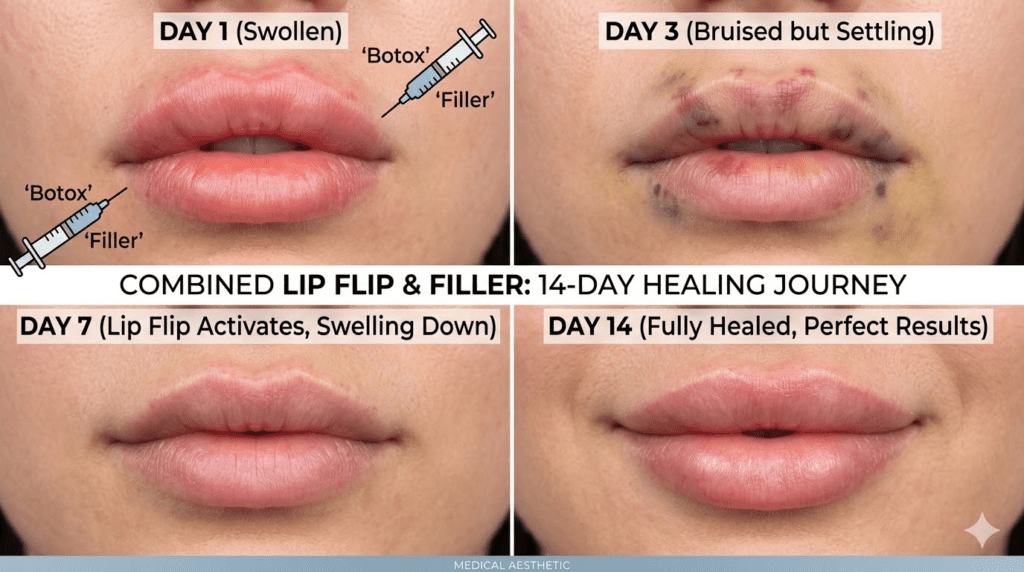
One of the most anxiety-inducing parts of any cosmetic injectable treatment is the recovery phase. When you combine a Botox lip flip with hyaluronic acid (HA) lip filler, you are introducing two different mechanisms to the lip tissue: one that temporarily alters muscle movement and another that physically expands tissue volume.
Understanding the lip flip and filler recovery timeline is crucial to prevent unnecessary panic. It is entirely normal for your lips to look asymmetrical, overly large, or bruised during the first few days. This is a natural inflammatory response, not the final aesthetic result.
How long does it take for a lip flip and filler to heal?
Optimized for Google Featured Snippet: How long does lip filler and lip flip swelling last? The initial acute swelling from lip filler peaks around Day 2 to Day 3 and significantly subsides by Day 7. The Botox lip flip takes 5 to 7 days to start working and up to 14 days to reach full effect. Therefore, the complete healing and settling process for a combined lip flip and filler treatment takes exactly two weeks (14 days).
Day-by-Day Combined Swelling Timeline
When you get both treatments simultaneously, your lips go through a very specific healing trajectory. Here is your definitive day-by-day guide:
Days 1 to 3: The Acute Inflammatory Phase
- Day 1 (The Day of Treatment): Your lips will feel numb from the topical lidocaine. As the numbing wears off, you will experience tightness, tenderness, and noticeable swelling. Your lips will look much larger than you intended—this is simply tissue trauma and water retention, not the filler itself.
- Day 2 (Peak Swelling): This is famously known as the “panic day.” Swelling usually peaks on the morning of Day 2. You may notice minor pinpoint bleeding marks or early signs of bruising.
- Day 3 (Bruising Emerges): The swelling might start to stabilize, but bruises often darken, turning purple or blue. The lip flip has not started working yet, so your upper lip will still move normally.
Days 4 to 7: The Transition Phase
- Days 4–5 (Swelling Subsides): You will notice a rapid reduction in the “duck-like” swelling. The lips will start to feel softer and less tight.
- Day 6–7 (The Flip Activates): Around this time, the neuromodulator (Botox) begins to take effect. You will feel a slight heaviness or restriction when trying to drink from a straw, whistle, or rub your lips together. The upper lip will start to gently roll outward, revealing more pink mucosa.
Days 10 to 14: The Final Settling Phase
- Day 10 (Integration): The hyaluronic acid gel begins to integrate smoothly with your natural lip tissue. Any residual lumps or bumps usually smooth out.
- Day 14 (The Final Result): By the two-week mark, 100% of the swelling has resolved, any bruising has faded, and the Botox has reached its peak efficacy. What you see on Day 14 is your actual, final result.
Essential Aftercare: Do’s and Don’ts for Optimal Healing
Proper aftercare can dramatically reduce your downtime and prevent complications like filler migration or asymmetrical healing.
The Golden Rules of Lip Injectable Aftercare:
- Do Apply Ice (Properly): Use a cold compress wrapped in a clean cloth for 10-15 minutes at a time during the first 24 hours to construct blood vessels and reduce swelling.
- Do Use Arnica Montana: Topical Arnica gel or oral Arnica supplements can accelerate the clearing of bruises.
- Don’t Exercise: Avoid rigorous cardio, heavy lifting, or hot yoga for at least 48 hours. Elevated blood pressure can exacerbate swelling and bruising.
- Don’t Massage Your Lips: Unless explicitly instructed by your provider to massage a specific lump, leave your lips alone. Premature massaging can cause the filler to migrate out of the vermilion border.
- Watch Your Sleeping Position: Sleeping directly on your face can push the freshly injected filler out of place and increase unilateral swelling. If you are struggling with your sleep setup, check out our strict medical guidelines on can I sleep on my side after lip filler to ensure you don’t compromise your results overnight.
When to Contact Your Injector (Red Flags)
While mild bruising and swelling are normal, certain symptoms require immediate medical attention. Your provider should educate you on the signs of a vascular occlusion (when filler accidentally enters or compresses a blood vessel).
Seek immediate help if you experience:
- Severe, unmanageable pain that worsens rather than improves.
- Skin discoloration that looks pale, white, or distinctively mottled (blanching) outside the immediate injection zone.
- Blisters or pustules forming on the lip or surrounding skin.
The Economics and Longevity of Lip Enhancements: Cost, Duration, and Maintenance (2026 Guide)
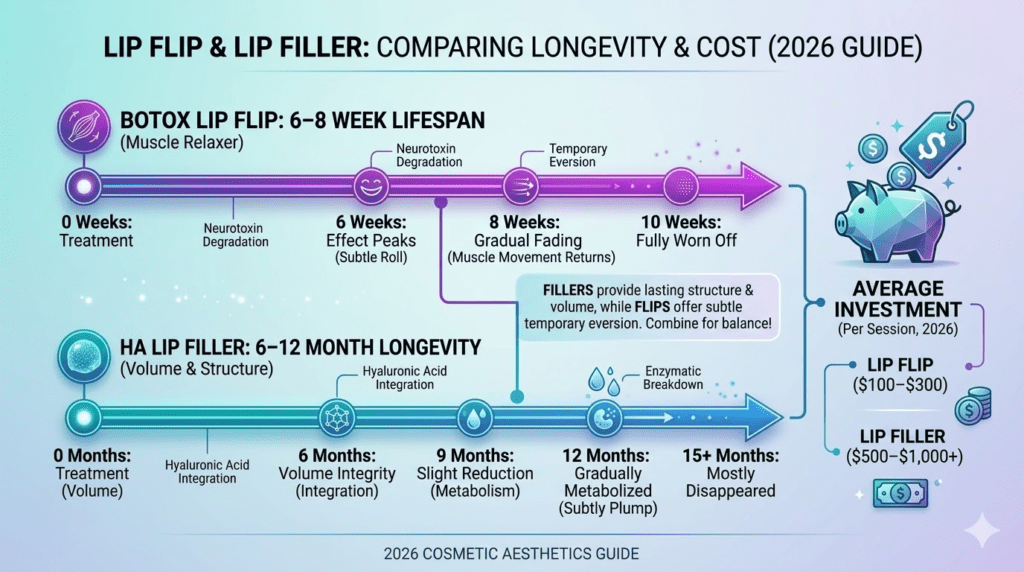
When considering a cosmetic procedure, two of the most critical factors for any patient are the financial investment and the aesthetic return on that investment. A lip flip and filler combination is highly customizable, meaning the final price tag and how long your results last will depend entirely on your unique biology, the specific products used, and your geographic location.
In 2026, transparency in cosmetic pricing is more important than ever. Here is a deep dive into the exact breakdown of what you are paying for, how long it will last, and how to maintain your ideal pout year-round.
How Long Does a Lip Flip and Filler Last Together?
It is crucial to understand that Botox (a neuromodulator) and Hyaluronic Acid (a dermal filler) degrade at completely different rates within the human body. Your lips will not suddenly return to their pre-treatment baseline overnight; instead, the results will gradually taper off in phases.
1. The Longevity of a Botox Lip Flip
A lip flip is a temporary treatment with a relatively short lifespan. Because the orbicularis oris muscle is in constant motion (from talking, chewing, smiling, and kissing), the neurotoxin breaks down faster here than it does in other areas of the face, like the forehead.
- Average Duration: 6 to 8 weeks.
- The Degradation Process: Around week 6, you will start noticing that your upper lip is regaining its full range of motion. By week 8 or 10, the “flip” effect will have completely worn off, and your lip will return to its natural resting position.
2. The Longevity of Hyaluronic Acid Lip Filler
Unlike Botox, dermal fillers provide long-lasting structural support. Hyaluronic acid is naturally metabolized and broken down by an enzyme in your body called hyaluronidase.
- Average Duration: 6 to 12 months (sometimes up to 18 months depending on the specific filler brand, such as Juvederm Volbella or Restylane Kysse).
- Factors Influencing Filler Lifespan: Your basal metabolic rate (BMR) plays a massive role. Highly active individuals, athletes, or those with naturally fast metabolisms tend to process and dissolve HA fillers much quicker than average.
The Combined Timeline
Because of this discrepancy in longevity, patients who get a combination treatment will notice the upper lip eversion (the lip flip) fading long before the volume (the filler) disappears. This is completely normal and requires a specific maintenance strategy, which we will discuss below.
Cost Analysis: How Much is a Lip Flip and Filler in 2026?
Cosmetic pricing is dictated by the provider’s expertise, the exact amount of product used, and the clinic’s location (e.g., a clinic in Manhattan, NY, will charge significantly more than one in a Midwest suburb).
Breaking Down the Botox Lip Flip Cost
Lip flips are generally priced “per unit” of neurotoxin.
- Average Units Needed: 4 to 6 units.
- Average Cost Per Unit: $15 to $25.
- Total Estimated Cost: $100 to $300 per session.
- Why it’s affordable: Because it requires such a micro-dose of Botox, it is one of the most budget-friendly aesthetic enhancements available today.
Breaking Down the Lip Filler Cost
Dermal fillers are generally priced “per syringe” (usually 1.0ml).
- Full Syringe (1.0ml): $600 to $1,000+.
- Half Syringe (0.5ml): $400 to $650 (Ideal for patients who only want a subtle hydration boost alongside their lip flip).
- Note on pricing: Premium fillers with advanced cross-linking technology (like the RHA Collection) tend to be at the higher end of the pricing spectrum due to their dynamic flexibility.
Total Combination Investment
If you sit in the injector’s chair for a combination treatment in 2026, expect your total bill to range anywhere from $600 to $1,300+.
The “Staggered” Maintenance Strategy
To keep your lips looking perfectly balanced all year round, expert injectors recommend a staggered maintenance schedule rather than waiting for both treatments to wear off completely.
- The Bi-Monthly Flip: Schedule a quick 10-minute appointment every 8 to 10 weeks exclusively for your Botox lip flip. This maintains the vertical height and prevents your gummy smile from returning.
- The Annual Fill: Schedule your dermal filler touch-up every 9 to 12 months. Because you are maintaining the lip flip regularly, you will likely find that you need less filler during your annual touch-up, saving you money in the long run and preventing the “overfilled” look.
Understanding the Risks, Side Effects, and Safety Protocols of Lip Injections
While the combination of a Botox lip flip and hyaluronic acid filler is overwhelmingly safe when performed by a highly trained, board-certified medical professional, it is still a medical procedure. The face is a complex network of arteries, veins, nerves, and muscles. Understanding the potential risks and side effects—and knowing how your injector plans to mitigate them—is the hallmark of a responsible patient in 2026.
Here is a transparent, clinical breakdown of what can go wrong, what is completely normal, and how modern aesthetic medicine handles complications.
Are lip flips and lip fillers safe?
Optimized for Google Featured Snippet: Are lip flips and fillers safe to get together? Yes, combining a lip flip and lip filler is widely considered safe when performed by a qualified, board-certified provider. Normal side effects include temporary swelling, bruising, and tenderness. However, severe risks like vascular occlusion (from filler) or ptosis (muscle drooping from Botox) can occur if the provider lacks deep anatomical knowledge. Always ensure your clinic has hyaluronidase on hand to reverse hyaluronic acid filler emergencies instantly.
Potential Side Effects of a Botox Lip Flip
Because a lip flip involves injecting a neurotoxin into the orbicularis oris muscle, the risks are primarily related to muscle function rather than tissue damage.
- Mild and Expected: You will likely experience a strange sensation when trying to purse your lips. Activities like whistling, sipping aggressively from a straw, or enunciating certain words (like “P” and “B” sounds) might feel slightly restricted for the first few weeks.
- Asymmetry: If the Botox is not distributed evenly, or if one side of your muscle is naturally stronger than the other, you may develop an asymmetrical smile. This is easily correctable with a micro-dose touch-up.
- Over-Relaxation (Ptosis): If too many units are injected (usually beyond the standard 4-6 units) or if the toxin spreads too deeply, it can cause the upper lip to droop, making it difficult to hold fluids in your mouth. Unlike filler, Botox cannot be dissolved; you must wait for it to wear off.
Potential Risks of Dermal Lip Fillers
Because lip filler physically introduces a gel-like substance into the tissue, the risk profile is slightly different and requires strict safety protocols.
1. Common, Non-Threatening Side Effects
- Asymmetrical Swelling: Your lips may swell unevenly during the first 3 to 5 days. This is perfectly normal and usually resolves on its own.
- The Tyndall Effect: If the hyaluronic acid filler is injected too superficially (too close to the skin’s surface), it can create a bluish tint on the skin.
- Delayed Onset Nodules: Sometimes, small, non-painful lumps (granulomas) can form weeks or months after treatment as the immune system reacts to the filler.
2. Severe Risks: Vascular Occlusion and Necrosis
The most serious complication of any dermal filler is a vascular occlusion. This occurs when the HA gel accidentally enters a blood vessel or compresses it from the outside, blocking the blood supply to the tissue.
- Signs of Occlusion: Immediate, severe pain, severe skin blanching (the skin turns white or gray), and a mottled, net-like pattern on the surrounding skin.
- Tissue Necrosis: If an occlusion is left untreated, the starved tissue can begin to die (necrosis), leading to permanent scarring. This is why choosing an injector who deeply understands facial vascular anatomy is non-negotiable.
3. Filler Migration
Over time, or if too much product is injected at once, filler can migrate outside the natural vermilion border, creating a puffy, “mustache-like” shadow above the upper lip. This is a tell-tale sign of poor injection technique or overfilling.
The Ultimate Safety Net: Hyaluronidase
The greatest advantage of using Hyaluronic Acid (HA) fillers over permanent fillers (like silicone or PMMA) is that they are 100% reversible.
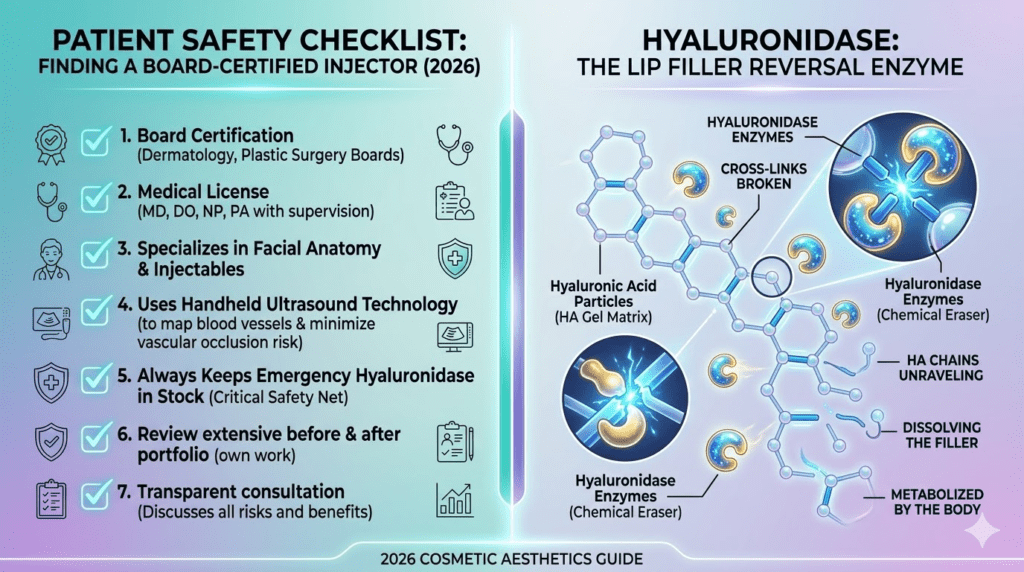
If you experience a vascular occlusion, filler migration, or are simply unhappy with the aesthetic outcome, your provider can inject an enzyme called Hyaluronidase (often branded as Hylenex). This enzyme acts like a chemical eraser, rapidly dissolving the cross-linked hyaluronic acid bonds within 24 to 48 hours, returning your lips to their natural state.
Crucial Safety Tip: Never receive lip filler from a provider who does not keep emergency hyaluronidase in stock at all times. In the event of a vascular occlusion, rapid dissolving is the only way to prevent permanent tissue damage.
How to Choose the Right Provider in 2026
To guarantee your safety and secure the best possible lip flip and filler before and after results, strictly vet your injector using these criteria:
- Medical Credentials: Look for Board-Certified Dermatologists, Plastic Surgeons, or specialized Registered Nurses (RNs) and Nurse Practitioners (NPs) who work under direct medical supervision.
- Ultrasound Technology: In 2026, top-tier clinics use handheld facial ultrasound devices to map out your blood vessels before injecting, drastically reducing the risk of vascular occlusion.
- Consultation Quality: A great provider will say “no” if your aesthetic goals are unsafe or structurally impossible for your natural anatomy.
Are You the Ideal Candidate? FAQs and Final Thoughts on Lip Enhancements

By now, you have a deep clinical and aesthetic understanding of how a Botox lip flip and hyaluronic acid (HA) lip filler work, both independently and synergistically. However, aesthetic medicine is never a one-size-fits-all approach. Your natural anatomy, muscle strength, and cosmetic goals dictate which treatment—or combination—is right for you.
Before booking your 2026 consultation with a board-certified injector, let’s determine your ideal treatment path and answer the most frequently searched questions on the web.
Who Is a Good Candidate for a Lip Flip?
A Botox lip flip is perfect for patients looking for a subtle, functional change rather than a massive structural volume increase. You are an ideal candidate if:
- You have a “Gummy Smile”: Your upper lip elevates too high when you smile, exposing a large amount of gum tissue.
- Your upper lip disappears: When smiling, your orbicularis oris muscle curls your upper lip inward, making it look paper-thin.
- You want a “test run”: You are hesitant about the permanence and volume of dermal fillers and want a temporary, affordable enhancement.
- You want vertical eversion: You are happy with your overall lip volume but want the top lip to gently roll outward for a slightly poutier resting face.
Who Is a Good Candidate for Lip Filler?
Lip filler is the ultimate solution for patients dealing with volume deficits, asymmetry, or deep tissue dehydration. You are an ideal candidate if:
- You have naturally thin lips: You lack structural volume in both the upper and lower lips and want a noticeable size increase.
- You have visible asymmetry: One side of your lip is noticeably smaller or flatter than the other, and you need precise structural correction.
- You want to reshape your lips: You desire a more defined cupid’s bow, a sharper vermilion border, or specific aesthetic proportions (like the Russian lip technique).
- You are experiencing volume loss due to aging: You want to restore a youthful plumpness and smooth out perioral (smoker’s) lines around the mouth.
Who Is a Good Candidate for the Combination Treatment?
You are the perfect candidate for a lip flip and filler combination if you want the absolute best of both worlds: structural volume and functional eversion. This is highly recommended for patients who want a hyper-natural look; by using the lip flip to roll the lip out, your injector can use significantly less filler (often just a half syringe), preventing the dreaded heavy, overfilled “duck lip” profile.
Frequently Asked Questions
To help you find quick answers, here are the most common questions regarding lip injections, formatted for direct clarity:
Does a lip flip hurt more than filler?
No, a lip flip is generally much less painful than lip filler. A lip flip requires only 4 to 6 tiny injections of Botox with a micro-needle, feeling like a quick pinch. Lip filler involves injecting a thicker gel deeper into the sensitive lip tissue. However, injectors always use a strong topical numbing cream (lidocaine) before filler to minimize discomfort.
Which one should I get first, the flip or the filler?
If you are doing both in the same session, most expert injectors will administer the dermal filler first to establish the structural shape and volume. Once the lip is sculpted, they will inject the Botox for the lip flip to relax the muscle and add the final vertical eversion.
Can a lip flip fix a gummy smile?
Yes, a Botox lip flip is the primary non-surgical treatment for a gummy smile. By relaxing the hyperactive elevator muscles above the mouth, the upper lip rests slightly lower, covering the gums when you smile naturally.
Does a lip flip make lips look bigger?
A lip flip does not physically add any volume or make your lips bigger in size. However, it creates the illusion of fuller lips by rolling the upper lip outward, allowing more of the pink tissue (mucosa) to be visible, especially when smiling.
Which treatment is better for thin lips?
For genuinely thin lips that lack structural tissue, lip filler is the better and more effective treatment. While a lip flip can roll the existing tissue outward, only hyaluronic acid filler can physically add the missing volume and plumpness required to transform very thin lips.
Final Thoughts: Achieving Your Dream Smile in 2026
When researching lip flip and filler before and after results, the most important takeaway is that aesthetic success lies in harmony, not just size. The era of overfilled, unnatural lips is over. Today, combining the muscle-relaxing finesse of a lip flip with the hydrating, structural support of hyaluronic acid filler represents the pinnacle of facial balancing.
Whether you choose a quick $200 lip flip to soften your smile or invest in a comprehensive combination treatment, always prioritize safety. Choose a highly qualified, board-certified medical professional who understands deep facial anatomy, uses ultrasound technology, and always has hyaluronidase on standby.
Your lips are one of your most defining facial features—trust them only to an expert who treats cosmetic injectables as both a science and an art.
Sources, References & Medical Authority
The clinical information, safety protocols, and product guidelines detailed in this guide are thoroughly researched and cross-referenced with the latest data from leading government health organizations and board-certified aesthetic medical authorities in 2026:
- U.S. Food and Drug Administration (FDA): For official safety communications, approved uses, and risk management regarding Hyaluronic Acid (HA) Dermal Fillers and Botulinum Toxin Type A. (Reference: FDA.gov – Dermal Fillers (Soft Tissue Fillers))
- National Institutes of Health (NIH) / PubMed: For peer-reviewed clinical studies on the efficacy of combining neuromodulators with dermal fillers, anatomical considerations, and the use of Hyaluronidase in managing vascular occlusions. (Reference: NIH.gov – National Library of Medicine)
- American Society of Plastic Surgeons (ASPS): For the latest industry standards, patient safety protocols, and statistical data on cosmetic injectables and minimally invasive procedures. (Reference: PlasticSurgery.org)
Medical & Earnings Disclaimer
Disclaimer: This article is strictly for educational and informational purposes and does not constitute professional medical advice, diagnosis, or treatment. The cosmetic procedures discussed, including Botox lip flips and dermal fillers, carry inherent medical risks and should only be performed by highly trained, board-certified healthcare professionals (such as Dermatologists, Plastic Surgeons, or specialized RNs/NPs under a medical director). Always consult with a licensed provider to determine if you are a suitable candidate for these treatments based on your individual medical history.

Sarah Mitchell is a dedicated aesthetic researcher with over a decade of experience analyzing cosmetic procedures. Obsessed with data and safety, she helps patients to provide real words and navigate the world of lip fillers with verified before and after results and honest cost breakdowns.