
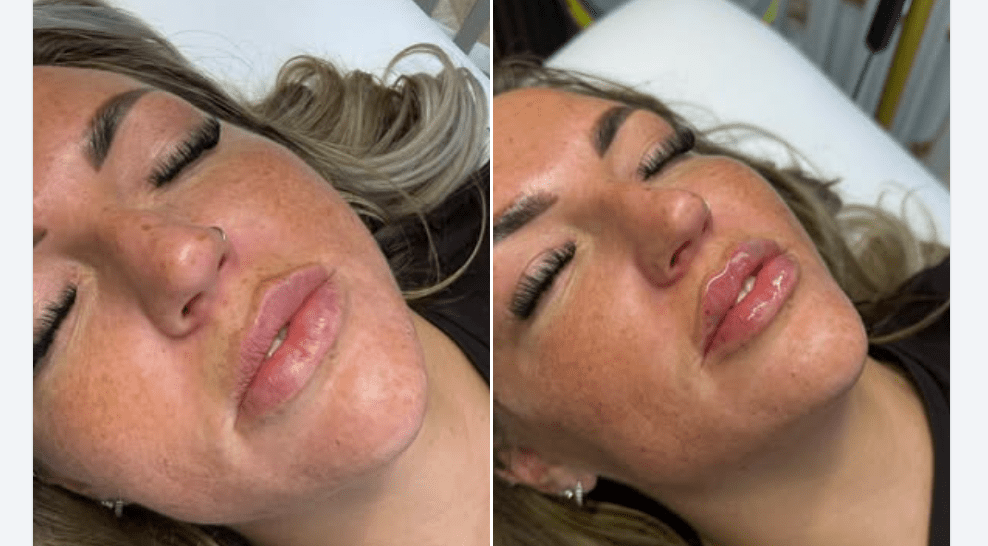
Quick Symptom Checker for Migrated Lip Filler: Is it Normal Swelling or Filler Migration?
If you are worried whether your lips are healing normally or the filler has migrated, use this table to self-check:
| Feature | Normal Lip Filler Healing (Days 1-14) | Lip Filler Migration (Weeks/Months Later) |
| Puffiness Location | Confined strictly to the pink part of the lips. | Puffiness spreading above the top lip line. |
| Visual Appearance | Plump, defined, and symmetrical. | “Duck lips” profile or a shadow above the lip. |
| The Lip Border | Sharp, crisp, and clearly defined. | Blurred, undefined, or completely lost border. |
| Texture & Feel | Firm initially, but softens naturally. | Hard, palpable lumps outside the natural lip area. |
| Timeline | Subsides naturally within 2 weeks. | Persists or gradually worsens over months. |
The Mirror Panic: Why Do My Lips Look “Off”?
We completely understand—you spent money on an aesthetic procedure to make your lips naturally plump and beautiful, but now looking in the mirror, you feel like something isn’t right. If you notice a strange swelling, a shadow, or an unnatural pout above your upper lip, you are not alone.
Lip filler procedures are the most popular non-surgical treatments in the world, but they come with a common (and fixable) complication known as Lip Filler Migration. There is no need to panic; this is not life-threatening and can be easily corrected. But before fixing it, you need to properly identify exactly what has happened to your lips.
What Exactly is Lip Filler Migration?
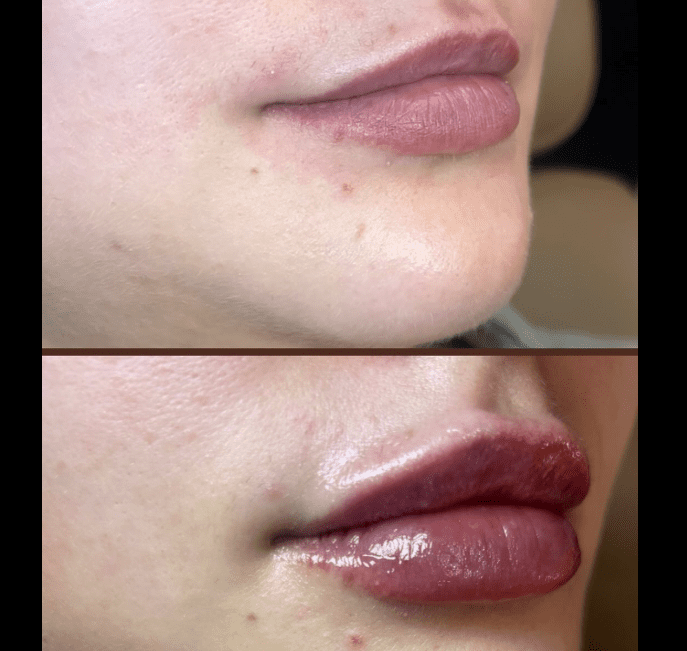
In medical terms, lip filler migration happens when an injectable dermal filler (usually hyaluronic acid or HA fillers like Juvederm or Restylane) moves away from its original injection site and shifts into the surrounding facial tissues.
Normally, the filler should stay within the body of your lips. But when it migrates, it crosses your vermilion border (the natural outer line of the lips) and shifts upward above the top lip, toward the philtrum columns, or into the corners of the mouth (oral commissures).
5 Tell-Tale Signs Your Lip Filler Has Migrated
If you are in doubt, check for these 5 major signs. If your symptoms match these, your filler has most likely migrated:
- 1. The Infamous “Filler Mustache”: This is the most common and obvious sign. When filler moves up into the skin above the upper lip, light reflects off it strangely, creating the illusion of a shadow or a “mustache,” even if there is no hair there.
- 2. Loss of the Vermilion Border: A well-injected lip filler sharpens the outline of your lips. With migration, this sharp line becomes blurred. You can no longer tell where the lips end and the normal skin begins.
- 3. The “Duck Lip” Side Profile: If you look at your face from the side (profile) and your upper lip forms an unnatural “shelf-like projection” pointing upwards instead of projecting naturally forward, this is a clear sign of overfilling or migration.
- 4. Lumpy or Uneven Texture: When you gently press your finger on the skin around your lips and feel small, hard (palpable) lumps outside the natural lip area, this is misplaced dermal filler.
- 5. Mouth Movement Issues: In extreme cases, migrated filler prevents your lips from closing properly. You feel a heavy, unnatural sensation when speaking or smiling.
Why Does Lip Filler Migrate? The Anatomy & Medical Truths
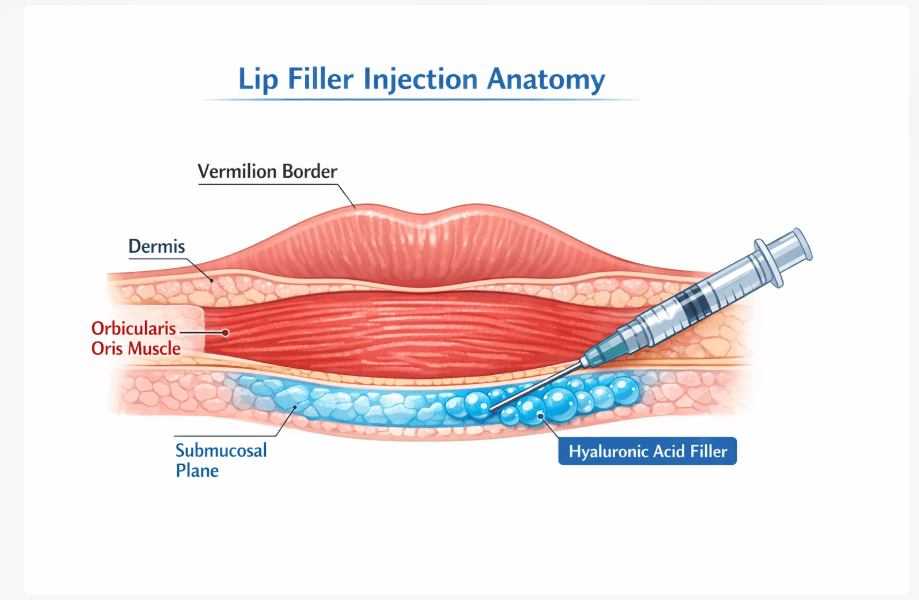
People often think that filler suddenly gets up and moves out of place on its own, but that is not the case. The migration of dermal filler is purely the result of anatomy, physics (tissue pressure), and injection technique.
When we inject hyaluronic acid (HA) gel into the lips, it is supposed to stay in a specific layer. But when these rules are broken, migration occurs. Here are the 5 major medical and technical reasons why your lip filler leaves its intended place:
1. Overfilling and Tissue Tension (The Balloon Effect)
Lip tissue has a natural, anatomical capacity. Your lips are like a small balloon. If you fill them with more filler (air) than their capacity can handle, pressure builds up. When the pressure and tissue tension inside the lips become too high, the HA gel looks for the “path of least resistance.” And that path is almost always outside the lip border (vermilion border), towards the upper lip.
2. Incorrect Anatomical Placement (Injector Technique)
This is the biggest technical fault. There is a round muscle inside the lips called the Orbicularis Oris. A highly skilled aesthetic injector knows that the filler must be placed in the correct submucosal plane.
- Placed Too Deep: If the filler is injected directly into the active muscle layer, the muscle will push the filler outward when it contracts.
- Placed Too Superficially: If the filler is placed just under the skin (on the surface), there isn’t enough proper tissue support to hold it there, causing it to easily migrate and form lumps.
3. The Wrong Type of HA Filler (Product Rheology)
Not all fillers are the same. The stiffness and elasticity of fillers are measured by their G-prime and BDDE cross-linking. For the lips, we need soft, flexible, and dynamic fillers (like Juvederm Volbella or Restylane Kysse) that can stretch along with the natural movement of the lips. If a practitioner uses a heavy/stiff filler meant for cheeks or the jawline in the lips, it will naturally clash with the lip movements and shift out of place.
4. High Dynamic Muscle Mobility
Your lips are the most active part of your face. You talk, eat, smile, and drink. This 24/7 dynamic muscle mobility creates a constant force. If the filler is placed even slightly incorrectly, this repeated movement slowly squeezes the filler gel into the upper lip area over time.
5. The “Stacking” Culture (Top-Up Overload)
Nowadays, people get a new “top-up” every 3 to 6 months without completely dissolving the old filler. With this “layering” or stacking, the leftover old filler gets pushed outward by the pressure of the new filler.
Medical Fact: Hyaluronic acid dermal fillers are hydrophilic (meaning they naturally attract water). Over time, accumulated filler and water retention stretch out your lip tissues, which eventually becomes the biggest cause of outward migration.
The Danger Zone: Is Migrated Lip Filler Dangerous? (When to See a Doctor)
In most cases, if your lip filler has migrated, it is strictly a “cosmetic” (appearance) issue. It is not life-threatening or dangerous to your overall health, and you can get it fixed at your own convenience and time.
However, because facial injections are a medical procedure, you must know the crucial difference between Normal Swelling and Medical Emergencies. If any of the following symptoms appear on your lips, you should immediately contact your practitioner or doctor.
URGENT MEDICAL WARNING (Red Flags to Watch For): > If you experience sudden, severe pain hours or days after the injection, or if your skin color starts turning white, pale, or bluish-purple, this is NOT filler migration. This could be Vascular Occlusion. This is a medical emergency that needs to be dissolved immediately to prevent permanent tissue damage.
The 3 Major Red Flags (Do Not Ignore These)
If your filler has moved out of place, keep an eye out for these 3 serious complications:
- 1. Vascular Occlusion & Ischemia (Blocked Blood Vessel): Sometimes, an injector might accidentally inject the filler directly into a blood vessel or place so much pressure on it that the blood flow stops entirely. This is called ischemia.
- Symptoms: Sudden whitening of the skin (blanching), delayed capillary refill, patchy discoloration (mottling), and severe pain that does not improve with over-the-counter painkillers. If this is not treated immediately with Hyaluronidase (dissolving enzyme), it can lead to tissue death (necrosis).
- 2. Delayed-Onset Nodules & Biofilms (Infection): If the area with the migrated filler suddenly feels hot to the touch, red, and inflamed, it could be an infection or a biofilm (a cluster of bacteria).
- Symptoms: Fever, pus discharge, or the sudden appearance of hard, painful lumps (nodules) months after the procedure. This may require professional antibiotics and steroid treatments.
- 3. Severe Allergic Reaction (Hypersensitivity): Hyaluronic acid is naturally found in the human body, so allergic reactions to it are very rare. However, you can have a hypersensitive reaction to the cross-linking agents (like BDDE) in the filler gel or the numbing cream (Lidocaine).
- Symptoms: Extreme swelling of the lips (angioedema), difficulty breathing, or severe itching and rashes around the mouth.
The Bottom Line on Safety
If there is just a shadow (mustache) above your lips or the shape simply looks off, but there is absolutely no pain or color change—Take a deep breath! You are completely safe. This is just a cosmetic migration issue that can be easily fixed.
How to Fix Migrated Lip Filler: The Ultimate Correction Guide
If your filler has truly migrated, the first thing you need to understand is: Do not panic, this is not permanent! Dermal fillers can be completely reversed.
But here is the biggest mistake most people make—they get more new filler injected on top of the migrated filler to camouflage (hide) it. This “Filler Stacking” makes the situation significantly worse, and your lips will start looking even more unnatural and heavy (giving a “duck lip” appearance). The only, and most effective, medical solution is to dissolve that filler.
The “Magic Eraser”: Hyaluronidase (Hylenex)
Because most modern dermal fillers are made of Hyaluronic Acid (HA), medical practitioners use an enzyme called Hyaluronidase (Brands: Hylenex or Hyalase) to dissolve them. This enzyme is injected directly into that misplaced filler pocket, where it breaks down the bonds of the HA gel, allowing your body to flush it out naturally.
Step-by-Step Process to Dissolve Migrated Lip Filler
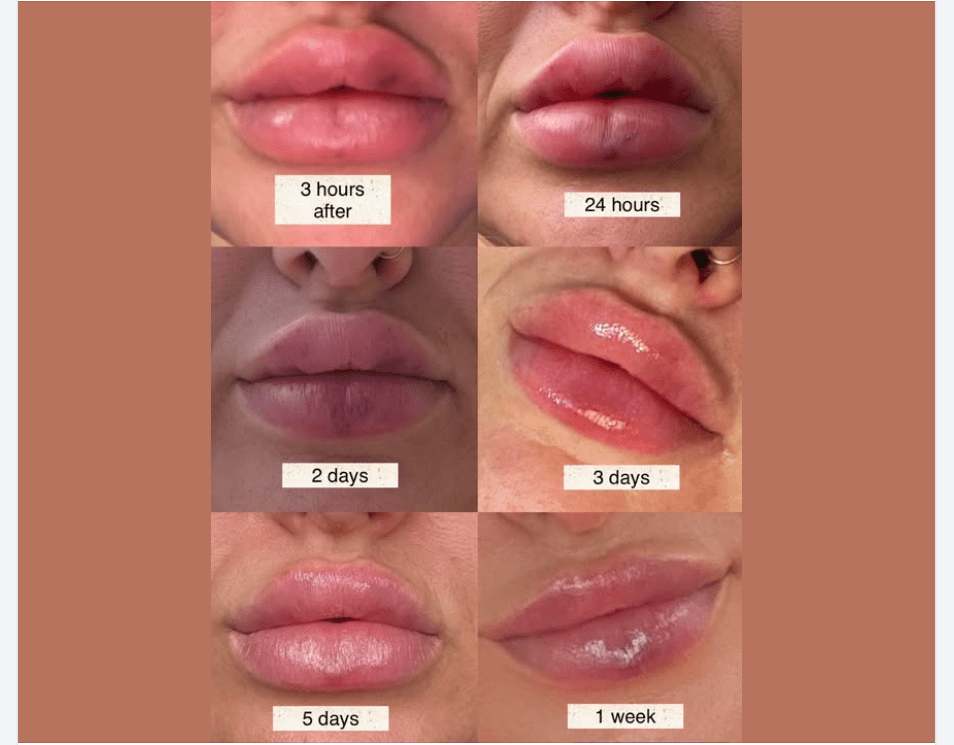
If you want your original, natural lip shape back, your aesthetic correction journey will look something like this:
- The Patch Test (Safety First): Hyaluronidase is an enzyme that some people may be allergic to (especially if they are allergic to bee stings). A reputable doctor will always perform a small patch test on your arm before starting the procedure.
- Precision Injection (Targeted Dissolving): The doctor will use an ultrasound or carefully palpate (feel) the area to inject the enzyme exactly where the filler has migrated (e.g., the upper lip border). Depending on your goals, only the migrated part can be dissolved (Partial dissolve), or the entire lip area can be brought completely back to a “Start Fresh” baseline (Full dissolve).
- The Immediate Breakdown: Hyaluronidase starts working the moment it is injected. The stubborn filler that has accumulated over the past months or years instantly starts to soften and break down.
- The 48-Hour Settling Period: In the first 24 to 48 hours, you might experience some post-procedure swelling or bruising. But after this subsides, you will see that the weird “filler mustache” and puffiness have completely disappeared.
Cost: How Much Does it Cost to Dissolve Lip Filler?
The cost always depends on your geographical location and the clinic’s authority. But generally, the cost of one session of Hyaluronidase can range between $150 to $500+. If you originally got a cheaper filler from a regular salon that ended up migrating, you will now have to go to an experienced, Board-Certified Medical Professional to get it dissolved, whose fees might come at a premium. But when it comes to the safety and aesthetics of your face, this cost is totally worth it.
Can I Just Massage Migrated Lip Filler Back into Place?
Short Answer: No. If you got your filler just a few days ago, a doctor might instruct you on a strictly guided massage technique to smooth out a minor lump. But if your filler has migrated weeks or months later, it is anatomically impossible to push it back into place. Extra massaging or aggressively pressing the lips will only increase tissue inflammation. The dissolving enzyme is the only real cure for this issue.
The “Start Fresh” Timeline: When Can I Get Lip Fillers Again?
If you have had your migrated filler dissolved, congratulations! You have taken the best step toward restoring your natural lip anatomy. But now the biggest question arises: “When can I get new filler injected?”
Some clinics might give you a 3 to 5-day window to rush you back in, but from a medical and anatomical perspective, this is a huge mistake.
When you get Hyaluronidase injected, your tissues swell, and the enzyme has its own “half-life” (the time it remains active in the body). If you get new HA filler injected immediately, the leftover enzyme will dissolve that new filler too!
- The Golden Rule: You should wait at least 2 to 4 weeks before getting new lip filler.
- If you had a lot of accumulated filler (stacking) and your tissue was stretched out, your doctor might even advise you to wait 4 to 6 weeks so your skin can naturally shrink and regain its original elasticity. Patience is key!
How to Prevent Lip Filler Migration in the Future
When your “Start Fresh” period arrives and you go back to get your lips done, you need a solid strategy to ensure this nightmare doesn’t happen again. Follow these rules:
1. Avoid the “1ml in One Go” Trap
Injecting a full 1ml (or more) syringe in a single session is a major cause of migration. Ask your injector to use “Gradual Layering.” Have them inject only 0.5ml in the first session, let it integrate with the tissue, and get the rest done 4 weeks later. This prevents tissue pressure from building up.
2. Choose the Right HA Product
Cheap or stiff fillers are not made for the lips. Always request premium, soft, and highly flexible fillers (like Restylane Kysse or Juvederm Volbella) that can stretch seamlessly with your daily lip movements.
3. The Ultimate Aftercare: Do’s and Don’ts Table
The first 48 hours post-procedure are the most critical. Follow this strictly guided checklist to lock your new filler in place:
| Action | Do’s (What to Do) | Don’ts (What to Avoid) |
| Drinking & Eating | Stay hydrated and eat soft foods. | Never use straws! Pouting forces the Orbicularis Oris muscle to push the filler upward. |
| Sleeping Position | Sleep with your head elevated on 2 pillows for the first 2 nights. | Do not sleep face-down (on your stomach) or on your side with your lips pressed into the pillow. |
| Physical Activity | Light walking is fine. Apply ice packs gently. | Completely avoid heavy gym workouts, yoga (headstands), or saunas (heat) for the first 48 hours. |
| Touching the Lips | Let the healing process happen naturally. | Do not aggressively massage or press your lips. Avoid “smacking” your lips together forcefully. |
Frequently Asked Questions (People Also Ask)
Will Migrated Lip Filler Go Away On Its Own?
Technically, yes, because Hyaluronic Acid (HA) fillers naturally dissolve in the body over time. However, in reality, migrated filler can stay there much longer than normal filler (sometimes up to 2 to 3 years). If the shape looks distorted, the best and most predictable option is to have it properly dissolved rather than waiting for it to resolve on its own.
Can I Fix Migrated Filler by Adding More Filler?
A big NO! This is the most common mistake, known as “camouflaging.” If you get more filler injected to hide the migrated filler (like a filler mustache), your lips will end up looking overfilled and unnaturally like “duck lips.” The correct approach is to dissolve the misplaced filler first and start over with a clean canvas.
Does Dissolving Lip Filler Hurt?
Before injecting the Hyaluronidase enzyme, your doctor will always use a strong numbing cream (topical anesthetic) or a dental block. The procedure is very fast. You might feel a slight stinging or pinching sensation when the enzyme is injected, but this pain is much less than getting the filler itself and subsides within seconds.
Can You Dissolve Just the Migrated Part Without Losing All My Filler?
Yes! If your injector is highly skilled, they can use a “Partial Dissolving” or “Micro-dosing” technique. They will inject a very small amount of the enzyme strictly into the area where the filler has migrated (like the upper lip border), ensuring the rest of your lip volume and shape remains intact and safe.
How Can I Tell if it’s Migration or Just Normal Swelling?
Normal swelling is always confined to the pink part of the lips (vermilion) and resolves naturally within 1 to 2 weeks. However, if the swelling persists for weeks and appears as a shadow or a shelf-like projection above the upper lip (outside the lip border), it is 100% filler migration.
Medical References & Sources
To ensure the highest level of accuracy and safety, the medical facts, anatomical references, and treatment protocols mentioned in this article are sourced from peer-reviewed dermatological and plastic surgery journals:
- National Library of Medicine (NIH) – Filler Migration & Injection Techniques: Study on the effects of different injection techniques used in lip augmentation and their direct role in hyaluronic acid filler migration. Source: Comparing the Effects of Injection Techniques on Filler Migration (PMC11253074)
- National Library of Medicine (NIH) – Hyaluronidase & Correction Protocols: Clinical practice guidelines on the safe use of Hyaluronidase in aesthetic medicine for correcting dermal filler complications, misplacement, and delayed-onset nodules. Source: Hyaluronidase Use in Aesthetic Medicine (PMC12787120)
- Aesthetic Complications Expert (ACE) Group – Vascular Occlusion & Safety: Official guidelines for the safe use of Hyaluronidase in aesthetic medicine, covering emergency protocols for vascular occlusion and ischemia caused by HA fillers. Source: Guideline for the Safe Use of Hyaluronidase in Aesthetic Medicine (PMC8570661)

Sarah Mitchell is a dedicated aesthetic researcher with over a decade of experience analyzing cosmetic procedures. Obsessed with data and safety, she helps patients to provide real words and navigate the world of lip fillers with verified before and after results and honest cost breakdowns.